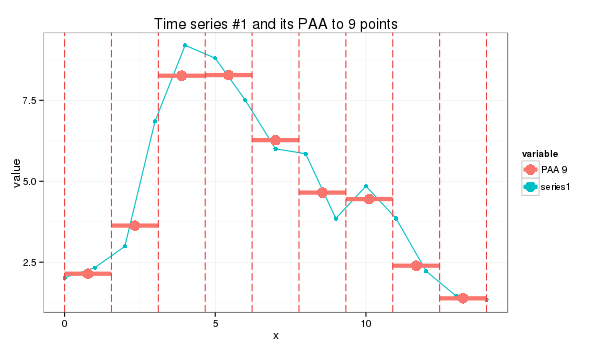
PAA approximates a time series X of length n with a vector \( \bar{X}=(\bar{x}_{1},...,\bar{x}_{w}) \) of any arbitrary length \( w \leq n \), where each \( \bar{x}_{i} \) is calculated as follows:
$$ \bar{x}_{i} = \frac{w}{n} \sum_{j=n/w(i-1)+1}^{(n/w)i} x_{j} $$This simply means that in order to reduce the dimensionality from n to w, we divide the series into w frames and compute the mean value of each frame. When n is not evenly divisible by w, segment boundaries fall between samples: a point straddling an edge contributes fractionally to both neighboring frames (see the 9-frame example below). The jMotif Java/R implementations use this fractional-boundary rule; only the evenly-divisible case reduces to plain block averages. The sequence assembled from these means is the PAA approximation (i.e., transform) of the original time series. (The PAA literature often denotes the reduced dimensionality by M; we use w throughout this site because, in the SAX context, it becomes the word size.) Computing the transform takes a single pass over the series. PAA is equipped with the distance measure
$$ D_{PAA}(\bar{X},\bar{Y}) \equiv \sqrt{\frac{n}{w}} \sqrt{ \sum_{i=1}^{w} \left( \bar{x}_{i}-\bar{y}_{i} \right)^{2} } $$and, as shown by Yi & Faloutsos and by Keogh et al., \(D_{PAA}\) lower-bounds the Euclidean distance,
$$ D_{PAA}(\bar{X},\bar{Y}) \leq D(X,Y) $$which guarantees no false dismissals when searching over the PAA representation.
Example
In this primer we use the following time series:
series1 <- c(2.02, 2.33, 2.99, 6.85, 9.20, 8.80, 7.50, 6.00, 5.85, 3.85, 4.85, 3.85, 2.22, 1.45, 1.34)
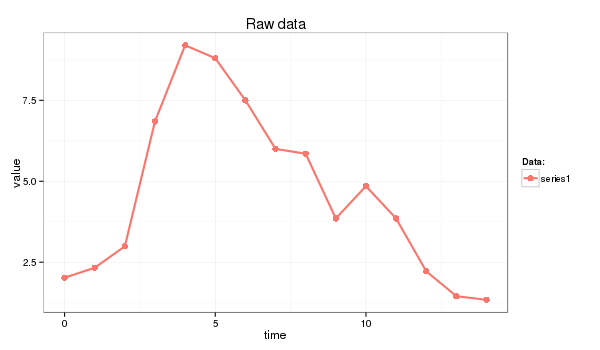
and the following R code:
paa <- function(ts, paa_size){
  len = length(ts)
  if (len == paa_size) {
    ts
  }
  else {
    if (len %% paa_size == 0) {
      colMeans(matrix(ts, nrow=len %/% paa_size, byrow=F))
    }
    else {
      res = rep.int(0, paa_size)
      for (i in c(0:(len * paa_size - 1))) {
        idx = i %/% len + 1 # the frame
        pos = i %/% paa_size + 1 # the point
        res[idx] = res[idx] + ts[pos]
      }
      for (i in c(1:paa_size)) {
        res[i] = res[i] / len
      }
      res
    }
  }
}
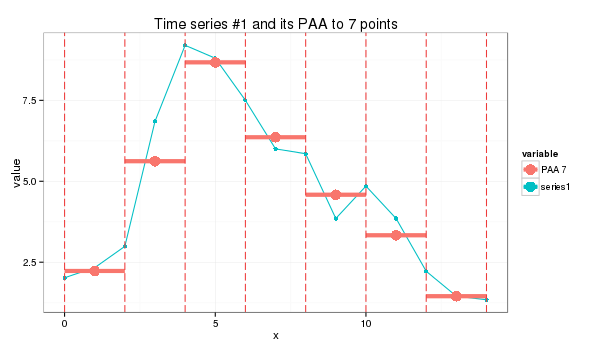
whose application produces a seven-point piecewise aggregate approximation:
s1_paa = paa(series1, 7)
(2.23, 5.62, 8.67, 6.36, 4.58, 3.33, 1.45)
or a 9-point approximation, which is a bit trickier — 15 points do not divide evenly into 9 frames, so boundary points contribute fractionally to two neighboring frames:
s1_paa = paa(series1, 9)
(2.14, 3.63, 8.26, 8.28, 6.27, 4.65, 4.45, 2.39, 1.38)