Z-normalization, also known as “normalization to zero mean and unit of energy”, was first mentioned by Goldin & Kanellakis. The procedure rescales the input vector so that the output has a mean of 0 and a standard deviation of 1:
$$x^{'}_{i}=\frac{x_{i}-\mu}{\sigma}, \text{ where } i \in \mathbb{N}$$First, the time series mean is subtracted from each value; second, the difference is divided by the standard deviation. According to most of the recent work on structural time series pattern mining, z-normalization is an essential preprocessing step: it lets a mining algorithm focus on structural similarities and dissimilarities rather than on amplitude-driven ones.
Note, however, that in some cases this preprocessing is not recommended, as it introduces biases. For example, if the signal variance is very small, z-normalization simply amplifies the noise to unit amplitude. In the extreme case of a constant time series, the standard deviation is zero and the transform is undefined — a division by zero. This is why practical implementations guard the division with a small threshold and skip the normalization when the variance falls below it.
Example
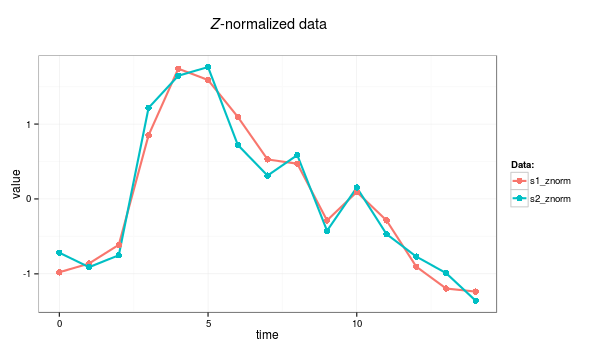
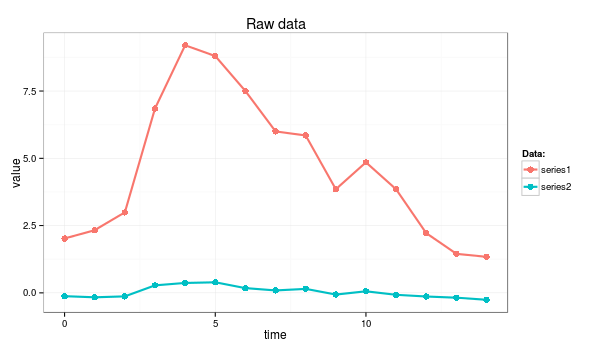
The example below demonstrates the highly desirable property of z-normalization: whereas the raw time series look very different, their z-normalized versions are nearly identical.
The raw time series
series1 <- c(2.02, 2.33, 2.99, 6.85, 9.20, 8.80, 7.50, 6.00, 5.85, 3.85, 4.85, 3.85, 2.22, 1.45, 1.34)
series2 <- c(-0.12, -0.16, -0.13,  0.28,  0.37,  0.39,  0.18,  0.09,  0.15, -0.06,  0.06, -0.07, -0.13, -0.18, -0.26)
Z-normalization can be coded as a simple R function:
znorm <- function(ts){
  ts.mean <- mean(ts)
  ts.dev <- sd(ts)
  (ts - ts.mean)/ts.dev
}

s1_znorm = znorm(series1)
s2_znorm = znorm(series2)
Note: These R snippets use base R
sd(), which divides by \(n-1\). The jMotif Java and R (jmotif) implementations use the population standard deviation (divide by \(n\), the Matrix Profile / MASS convention). For stack-identical numerics, usesqrt(mean((ts - mean(ts))^2))or thejmotifpackage instead ofsd().
The time series after z-normalization